1. Why This Matters for Australian General Counsel In recent years, an increasing number of Australian companies have been acquiring Japanese companies or Japanese real estate assets. One key driver is corporate strategy under the weak Japanese yen, which has made Japan an attractive investment destination. From a legal perspective, these transactions often qualify as mergers and acquisitions, even when they appear to be straightforward real estate purchases. For example, acquiring shares of the single purpose company which owns a Japanese real property typically constitutes an M&A transaction under Japanese law. For Australian General Counsel, Japan presents a unique challenge. The legal system, market structure, and availability of legal professionals […]
Overview Many US companies establish their Asia-Pacific headquarters (APAC HQs) in Singapore and place their General Counsel or regional legal team there, with responsibility for overseeing Japan operations. This structure functions effectively for regional governance and compliance. However, when a legal issue arises in Japan—particularly debt collection against a Japanese counterparty—it is essential to understand how the Japanese legal system operates in practice. This article provides a concise, practitioner-oriented overview of Japanese debt collection procedures, focusing on key considerations for in-house and external counsel based in Singapore. A typical scenario is straightforward: a Japanese retailer or distributor fails to pay the contract price. The legal response, however, requires a jurisdiction-specific […]
We are pleased to announce that our firm will be Lanyard sponsor of the “ALB Japan In-House Legal Summit 2026,” hosted by Asian Legal Business (ALB). This summit will be held on Wednesday, April 15, 2026, at The Hilton Tokyo. It is an event designed for corporate legal professionals, offering a wide range of information on the latest legal trends and practical insights. Through presentations and panel discussions featuring domestic and international experts, it will provide a valuable opportunity to exchange views on the challenges and solutions facing corporate legal departments going forward. As a sponsoring firm, we sincerely look forward to your participation. For details and registration information, please […]
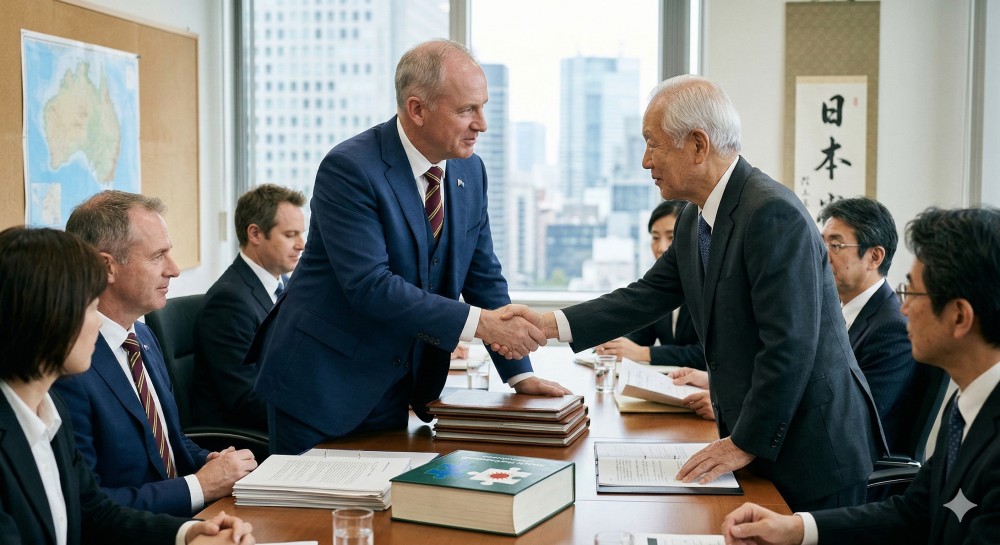
Strategy and dialogue culminate in mutual trust, as leaders shake hands in Singapore, preserving partnership and securing a sustainable future together.
By Shingo Hattori — Founder & Managing Partner, Hattori LawTel: +81 3 6447 5586 Overview Even though there are various Acts regarding labor matters in Japan, Labor Standards Act is the fundamental one. Japanese Labor Standards Act has a base on Japanese Constitutions Article 27.2 “Standards for wages, hours, rest and other working conditions shall be fixed by law.” Labor Standards Act stipulates minimum standards of work conditions to protect workers from their position regarding economical viewpoints. Labor Standards Act Article 1.1 stipulates the very point as “Working conditions must be conditions meeting the needs that are to be met in order for worker to live a life worthy of a […]
Position Attorney (Licensed in Japan or another jurisdiction) PQE 2 or more Job Description Our firm handles a wide range of corporate legal matters, including cross-border transactions and international legal issues. Depending on your interests and areas of expertise, you will be assigned to various legal tasks across multiple practice areas. Language Skills English (Native-level proficiency) Employment Type Full-time Eligibility The candidate must meet the legal requirements for working in Japan. Working Hours 9:30–17:30 (1-hour break) *Flexible hours, remote work, and shortened hours available upon request. Work Location Roppongi Hills North Tower 3F, 6-2-31 Roppongi, Minato-ku, Tokyo Compensation Compensation will be determined based on experience and previous salary, following consultation. […]
By Shingo Hattori — Founder & Managing Partner, Hattori LawTel: +81 3 6447 5586 Japan’s Foreign Exchange and Foreign Trade Act (FEFTA) imposes strict reporting rules on foreign investors. Even small share purchases can trigger filings: for example, acquiring as little as 1% of a listed company now requires pre‑notification. Foreign investment in certain “sensitive” industries (e.g. defense, energy, high-tech) mandates prior government approval, and post-closing notification is required for non-residents buying land (within 45 days). The 2022 Act on the Review and Regulation of the Use of Real Estate Surrounding Important Facilities and on Remote Territorial Islands (“REIRA”)adds a location-based review: any purchase of real estate within ~1,000 meters of […]
By Shingo Hattori — Founder & Managing Partner, Hattori LawTel: +81 3 6447 5586 Successful international deals with Japanese partners hinge on both legal clarity and cultural sensitivity. Parties should prepare agendas in advance and respect formalities: for instance, Japanese counterparts appreciate receiving a written meeting agenda and a polite exchange of business cards (“meishi” in Japanese) using both hands. Contracts must adhere to Japanese formalities – many Japanese firms execute key agreements with an official corporate seal (“inkan” in Japanese) rather than a signature, which legally binds the entity. Legal practitioners should also plan for language and forum issues: Japan’s Arbitration Act follows the UNCITRAL Model Law, enabling arbitration in […]
By Shingo Hattori — Founder & Managing Partner, Hattori LawTel: +81 3 6447 5586 Japan’s hospitality business sector is open to foreign investment. There are no nationality-based ownership restrictions on hotels or restaurants. However, operating a lodging facility requires a government license. Under the Hotel Business Act, any facility offering accommodation to fee-paying guests must obtain a hotel or inn license from the local health/amenity department. Standards cover safety, hygiene and staffing ratios. Short-term rentals (so-called “minpaku” in Japanese, Airbnb-type lodgings) fall under the 2018 Private Lodging Business Act; hosts must register their property and may only rent it for a limited number of days per year (commonly 180). Foodservice businesses […]
By Shingo Hattori — Founder & Managing Partner, Hattori LawTel: +81 3 6447 5586 Japanese land-use law is rigorous. The City Planning Act divides every area into one of 13 “Land Use Zones” (residential, commercial, industrial, etc.) that strictly control permitted uses and building dimensions. Developers must confirm that any proposed use (e.g., hotel, office, retail) is allowed in the zone, and that floor-area and coverage ratios comply with both national rules and local ordinances. Non-conforming buildings can be ordered modified or even demolished by local authorities. Environmental due diligence is critical: under the Soil Contamination Countermeasures Act, purchasers inherit full liability for any preexisting pollution on the site. Older buildings […]
By Shingo Hattori — Founder & Managing Partner, Hattori LawTel: +81 3 6447 5586 Focus on: Japanese law and best practice put growing emphasis on robust compliance systems and crisis readiness. The Principle 2.5 of the Japanese Corporate Governance Code stipulates as follows. “Companies should establish an appropriate framework for whistleblowing such that employees can report illegal or inappropriate behavior, disclosures, or any other serious concerns without fear of suffering from disadvantageous treatment. Also, the framework should allow for objective assessment and appropriate response to the reported issues, and the board should be responsible for both establishing this framework, and ensuring and monitoring its enforcement.” The Supplementary Principle of the […]
It was my pleasure to be a panelist for the discussion titled “Redefining Hospitality through AI, IoT & Digital Twins” in the Hotel Revenue Summit Japan of the Hospitality Japan Conference at The Capitol Hotel Tokyu, which is located very close to Japanese Prime Minister’s Office, Tokyo, Japan. A moderator was Imam Habib san with great expertise in VC. Panelists were Yusuke Sunagawa san in AI, Touki Hata san in hotel operation system, and me in legal space. We explored what will happen next in the hotel revenue management field in AI era. I really enjoyed it. I know how regulations or laws work while it’s very worthwhile to know […]