
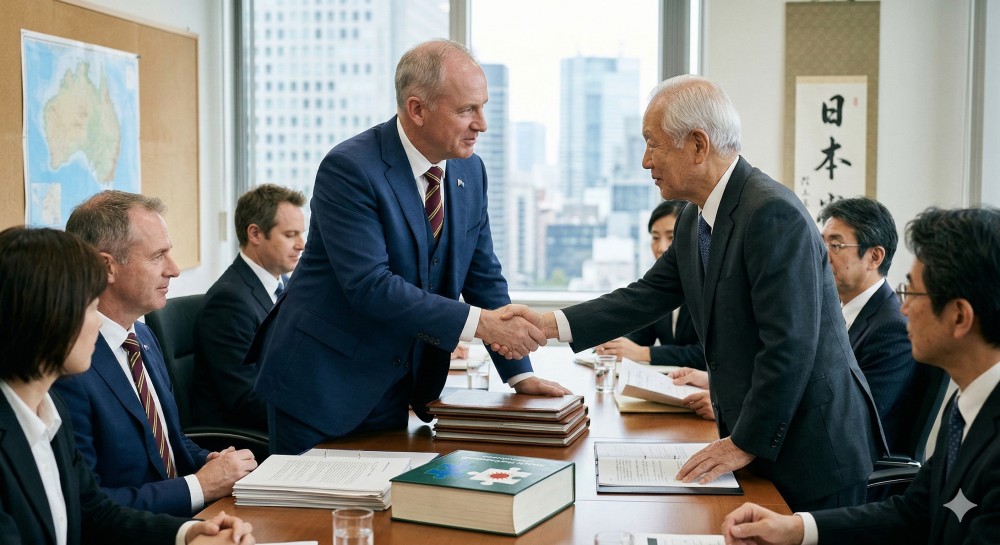
In recent years, an increasing number of Australian companies have been acquiring Japanese companies or Japanese real estate assets. One key driver is corporate strategy under the weak Japanese yen, which has made Japan an attractive investment destination.
From a legal perspective, these transactions often qualify as mergers and acquisitions, even when they appear to be straightforward real estate purchases. For example, acquiring shares of the single purpose company which owns a Japanese real property typically constitutes an M&A transaction under Japanese law.
For Australian General Counsel, Japan presents a unique challenge. The legal system, market structure, and availability of legal professionals differ significantly from those in Australia. This article explains how Australian General Counsels should think about team building for M&A and post‑merger integration (PMI) when entering the Japanese market
In Japan, M&A transactions commonly take one of the following forms:
・Share acquisitions of a Japanese target company; or
・Asset acquisitions, where the buyer acquires the Japanese business or assets without purchasing shares.
Both structures are treated as M&A under Japanese law, but the legal and administrative implications differ substantially.
For large‑scale transactions, Australian companies often engage multinational law firms with Japan offices. These firms can cover a wide range of legal issues and may be appropriate where transaction size and complexity justify the cost.
However, for mid‑sized or smaller transactions, this approach is not always cost‑effective. In such cases, Australian General Counsels frequently consider engaging Japanese local counsel to manage the transaction. This is where practical challenges often arise.
From an Australian General Counsel’s perspective, one of the most critical differences is the limited supply of Japanese lawyers, particularly those with cross‑border experience.
Japan has approximately 46,000 registered lawyers serving a population of 125 million, whereas Australia has around 110,000 lawyers for a population of 27.6 million. In practical terms, Japan has roughly one‑tenth the lawyer density of Australia.
Moreover, only a small subset of Japanese lawyers regularly handle:
・corporate and commercial matters;
・cross‑border M&A; and
・English‑language legal work involving common law concepts.
As a result, identifying suitable legal counsel for small to mid‑sized Japan‑related transactions can be time‑consuming and requires careful screening. For Australian General Counsels, locating a capable boutique or mid‑sized Japanese law firm is often the key to a successful deal.
Post‑merger integration is not merely an administrative follow‑up to closing. Its ultimate purpose is to ensure that the acquisition generates sustainable value. The scope of PMI depends heavily on transaction structure:
・In share acquisitions, changes to business licences, company names, or board composition may require filings with Japanese government authorities.
・In asset acquisitions, the process is more complex. Ownership of each asset must be transferred individually, often requiring detailed asset lists and separate registration or license transfer procedures.
Even after these formal steps are completed, Australian acquirers must still establish a new operational and compliance framework to run the Japanese business smoothly. Minor but persistent legal and administrative issues frequently arise during this phase.
For Australian General Counsels, this is where having reliable Japanese counsel who can act as a day‑to‑day legal contact point becomes particularly valuable.
Effective PMI requires legal professionals who are not only familiar with Japanese general corporate law but also capable of working within a common law mindset.
Legal English proficiency alone is not sufficient. Counsel must understand the structural and conceptual differences between civil law and common law systems. This is especially important as Japan’s regulatory environment for foreign investment continues to evolve.
For example, transactions that were previously lightly regulated—such as foreign ownership of Japanese real estate—now increasingly require disclosure of governing law and corporate information of foreign entities. Regulatory changes of this nature occur frequently, and missing them can expose Australian acquirers to unnecessary risk.
Engaging appropriate Japanese legal counsel allows Australian General Counsels to manage these risks proactively and maintain compliance in a rapidly changing regulatory landscape.
While large international law firms can certainly provide these services, they may not always be the best fit for smaller or mid‑sized Japan operations.
In many cases, a boutique international or Japan‑focused law firm offers a more cost‑effective and practical solution for ongoing general corporate and PMI support. Such firms can combine local regulatory knowledge with cross‑border experience, aligning more closely with the needs of Australian General Counsels managing lean legal budgets.
For Australian General Counsel considering or managing acquisitions in Japan:
・Japan‑related M&A requires early planning for post‑merger integration.
・The scarcity of cross‑border‑capable Japanese lawyers makes counsel selection critical.
・Transaction size and structure should drive the choice between large firms and boutique counsel.
・Ongoing general corporate support is essential to protect value post‑closing.
Careful selection of Japanese legal counsel, aligned with the scale and nature of the transaction, is one of the most important decisions Australian General Counsels will make in Japan‑focused M&A.
Hattori Law (hrtlawfirm.com) is a Tokyo-based international business law firm founded by Shingo Hattori. The firm provides bilingual legal support for foreign investment, corporate matters, and hospitality businesses, including due diligence, English-Japanese contract negotiation, and regulatory compliance. Based in Roppongi Hills North Tower, the firm was a finalist at the ALB Japan Law Awards 2025. ⚖️🌏
Shingo Hattori – Founder & Managing Partner, Hattori Law +81 3 6447 5586
Daini Tokyo Bar Association:
Disclaimer: This article provides general information as of the time of drafting only and does not constitute legal advice. Specific advice requires review of transaction documents and facts.